
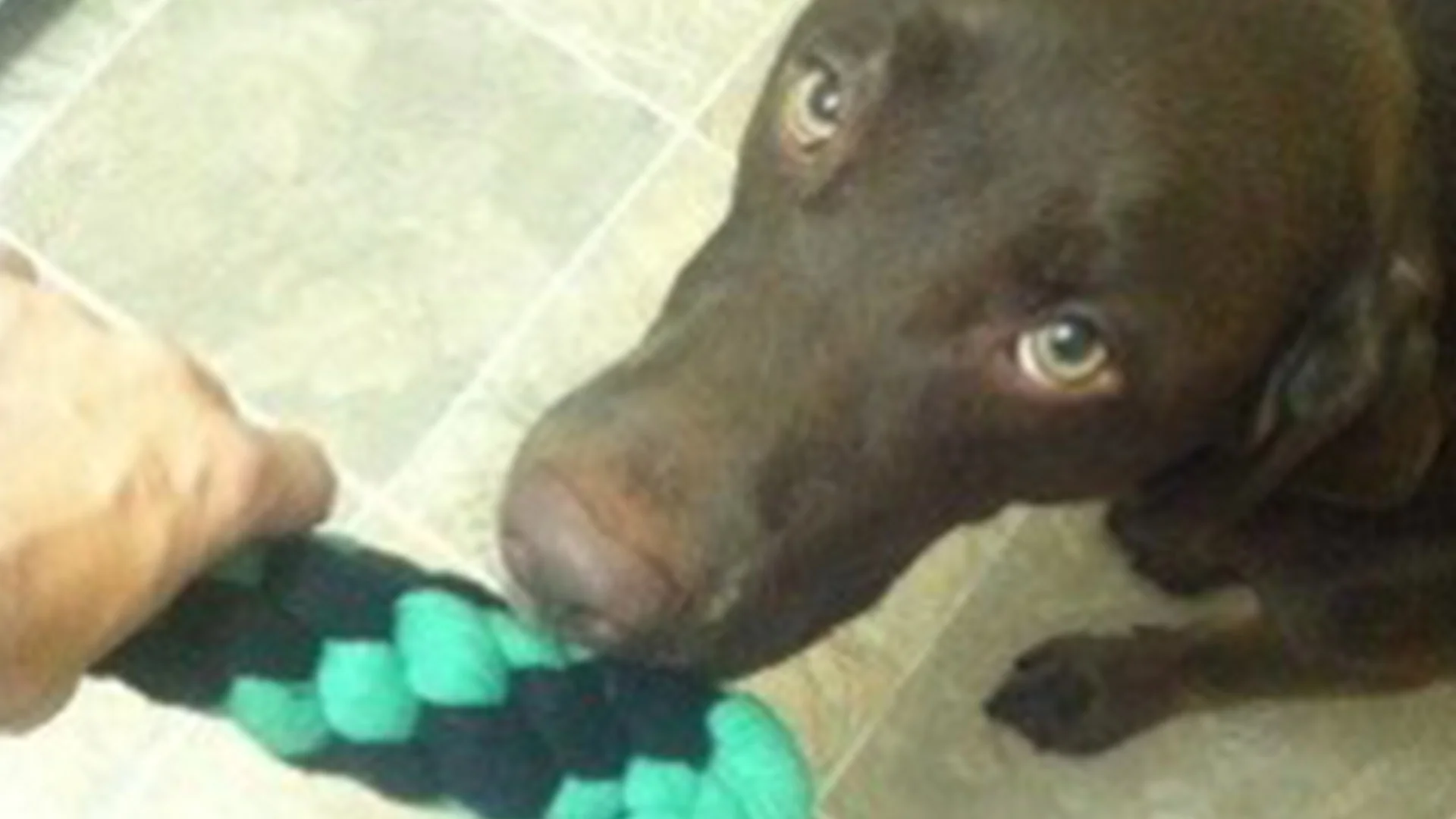
To teach a service dog to retrieve, begin with a safe object, a familiar reward marker and small, rewarded steps. This first part of AP’s series moves from nose targeting to voluntarily taking the object. Later parts develop a comfortable hold, release and pickup.
Retrieving is the foundation for more Service Dog tasks than we’d care to try to count. Tasks like opening doors, carrying bags, picking up dropped items, fetching the phone, delivering messages and helping a handler to dress/undress all begin with retrieving. If a human would use their hands to do something, it’s likely a Service Dog is going to use their mouth, which means retrieving. By teaching your Service Dog to retrieve, you open up a whole new realm of task work possibilities.
When teaching the retrieve, it’s important to remember the end goal: creating a happy, motivated worker who clearly understands what they’re being asked to do. In this case, your goal is to teach your Service Dog to retrieve, or pick up and hold until released, an appropriate, safe object selected for the task. It’s vital that you take things as slow as is necessary for your partner. Trying to rush will only create frustration and stress and will wreak havoc on the training process. Training a Service Dog to reliably retrieve takes a lot of time, patience and understanding, but the end results are well worth it.
SD Axel nose-bumps a retrieving dummy.
There are many different methods of teaching a Service Dog to retrieve, but we’re going to present the “motivational retrieve,” or a method of teaching the Service Dog retrieve that relies solely on positive reinforcement and shaping. Reward-based retrieval avoids forced handling; dogs who are taught to retrieve using motivational methods tend to be happier workers and they’re usually less stressed and fearful than Service Dogs who are taught to retrieve using force or pain-based methods.
Choose foundation exercises suited to the individual dog’s age, health and interest. Use purpose-made, safe objects of appropriate size; do not give puppies glass bottles, metal pieces, keys or pipe fragments to mouth as toys.
Prerequisites
Before beginning to train your Service Dog to retrieve, choose an accessible reward marker, such as a clicker or a consistent word. Timing is vital during retrieval training, and you need to be confident of your ability to get it right before starting to teach your Service Dog to retrieve. You also need to understand that retrieval training is a process and that it will take as long as it takes.
Your puppy or dog needs to understand your reward marker, able to focus on you for short periods of time, and know the basics of how to target.
Things You’ll Need
- A safe, appropriately sized retrieving dummy suited to your dog.
- A clicker or another consistent, accessible reward marker.
- Small rewards your dog enjoys and can safely eat.
SD Axel mouths a retrieving dummy.
Targeting
- Sit in a chair with your Service Dog facing you.
- Hold the dumbbell and clicker in one hand and treats in the other.
- Present the dumbbell to your partner. Click and treat for nose bumps.
- Move the dumbbell from side to side. Continue clicking and treating for nose targeting. Ignore pawing, vocalizing or anything except nose bumps.
- Continue practicing until your Service Dog will move a couple feet in either direction to nose bump the dumbbell.
Mouthing
- Move in small steps from investigation to voluntary mouth contact. Reward an offered opening or brief comfortable touch to the object. If the dog becomes confused or frustrated, make the step easier, try a safe familiar object or take a break; do not wait for distress to produce a response.
- Continue to ignore nose bumps. Click and treat once for your Service Dog’s mouth opening, and jackpot if he actually brushes or touches the dumbbell with any part of his mouth for any reason, even if it’s an accident.
- Work towards your Service Dog purposefully putting his mouth on the dumbbell, even if he spits it out instantly. Click and treat for mouth to dumbbell contact.
- Begin clicking and treating only for actual “grabs,” which are mouth opens, teeth close around middle of dumbbell, no matter how briefly, and then dog lets go.
That’s it for Part One! Look out for Part Two of training the Service Dog retrieve. Part Two develops a comfortable hold and release. Check out the attached video to see how to go from the super quick snatches to encouraging just a bit of duration.
Watch the original linked video
If the dog does not progress, check the object, reward and session difficulty. A qualified trainer can help with a suitable shaping plan. Avoid frozen-food gripping exercises or smearing unverified ingredients onto equipment; hard or swallowable objects and xylitol-containing products can be hazardous.
Making practice easier
Arrange the object, marker and rewards where you can use them comfortably. A helper or stable surface may make the setup easier. If your partner needs to be on-lead to keep him from wandering off, use a comfortable, supervised setup that does not trap or distress the dog. Use super high-value, special treats while teaching your Service Dog to retrieve. The more interest and focus you can generate in the process, the quicker your partner will progress.
When to take a break
The formal retrieve is a difficult and frustrating behavior not only for your Service Dog to learn, but also for you to teach. Take breaks as necessary, keep the energy high and above all, relax. If you feel yourself getting frustrated, ask your partner to perform a couple of quick, easy, fun behaviors he knows well and then end the session. Be careful not to drop the dumbbell or whatever object you are using on your feet or your Service Dog’s paws — it hurts!
Continue the retrieve series
- Part One: Getting started
- Part Two: A comfortable hold and release
- Part Three: Picking up and introducing objects
- Applying the skill: Retrieving a beverage