

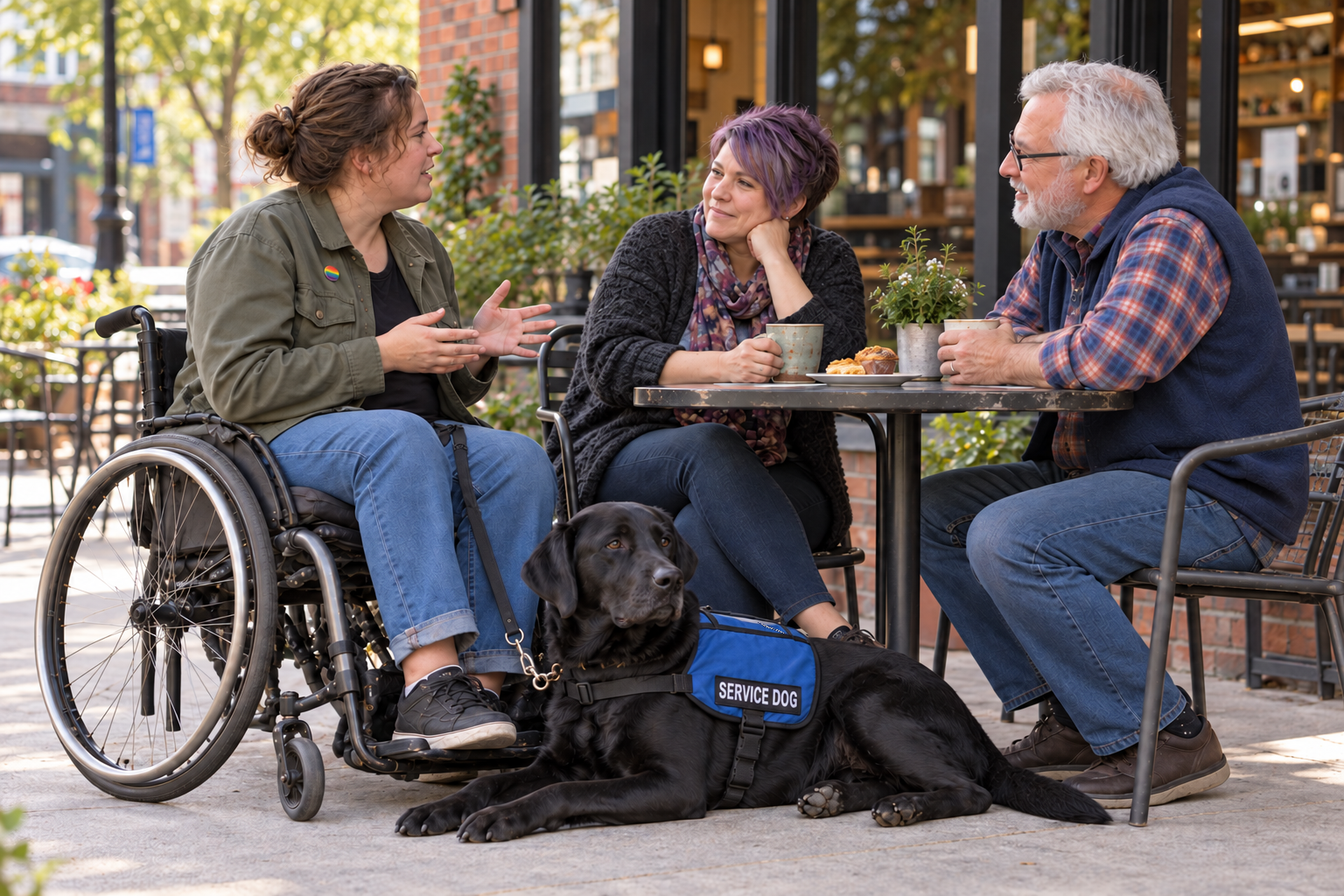
You’re welcome here, whether you’ve worked with a service dog for years, are wondering whether one might help you, or care about someone who does. There’s room for experienced handlers and people asking their first questions.
Life with a disability can involve a lot of explaining. A routine errand may bring questions you didn’t invite. Finding a trainer or getting to an appointment may take more time, money, or energy than someone else realizes. We want AP to be a place where you can find useful information and thoughtful conversation, and be treated with respect.

A community with room for you
Some disabilities are visible; many aren’t. We welcome people with chronic illnesses, psychiatric, sensory, mobility, and developmental disabilities, complex medical conditions, and neurodivergent people. Your experience doesn’t have to resemble someone else’s to deserve consideration.
That welcome extends to owner-trained and professionally trained teams, people considering a service dog, and the trainers, caregivers, healthcare professionals, advocates, educators, families, and friends who support them.
People of every race, ethnicity, nationality, language, culture, and faith are welcome here. So are veterans and civilians, people of every income level, and people in cities, suburbs, and rural communities. We welcome LGBTQ+ people and families, including all sexual orientations, gender identities, and gender expressions.
Different paths, shared responsibilities
A qualified trainer may be hours away. Healthcare appointments may come with long waiting lists. Training costs, transportation, language barriers, discrimination, and a lack of local support can put useful help out of reach. Those barriers deserve to be understood, including when someone’s disability is questioned or their identity or family circumstances make supportive services harder to find.
We support responsible service dog partnerships while recognizing that people have different resources. Training, behavior, safety, accountability, and consideration for others all matter. So does making room for people whose path looks different from our own. We don’t want unnecessary barriers to keep responsible teams from getting support.
How we treat one another
Ask questions. Share what you’ve learned. Leave room for someone else’s experience to be different. Good-faith disagreement can help us learn when we approach it with curiosity and respect.
Harassment, intimidation, discrimination, hostility, and deception undermine that trust. We ask everyone who takes part in this community to consider the dignity, safety, and wellbeing of others.
Making AP easier to use
Accessibility also means being able to read an article, follow a link, or use a form. We’re working to make our websites, services, forms, profiles, and tools easier to use with screen readers, keyboards, voice controls, magnification, mobile accessibility features, and other assistive technology.
Clear language, readable pages, and a usable phone layout are part of that work. We also know that some readers use browser translation or other tools to access information. We don’t currently support every language or every access need, and there will be things we need to improve.
Tell us what would help
If a page, form, or feature gets in your way, please contact us. You can also ask for information in another format or suggest an improvement. Tell us which page or feature you were using, what you were trying to do, and what made it difficult. Details about your browser or assistive technology can help, if you’re comfortable sharing them.
We’ll do our best to help you access the information and improve the experience.
AP shares these commitments with Service Dog Standards and the United States Service Dog Registry, operated by EBC Partners LLC. Service Dog Standards supports disabled people working with service dogs, people exploring whether a service dog may meet their disability-related needs, and the communities around them.
Image from the Service Dog Standards archive.