
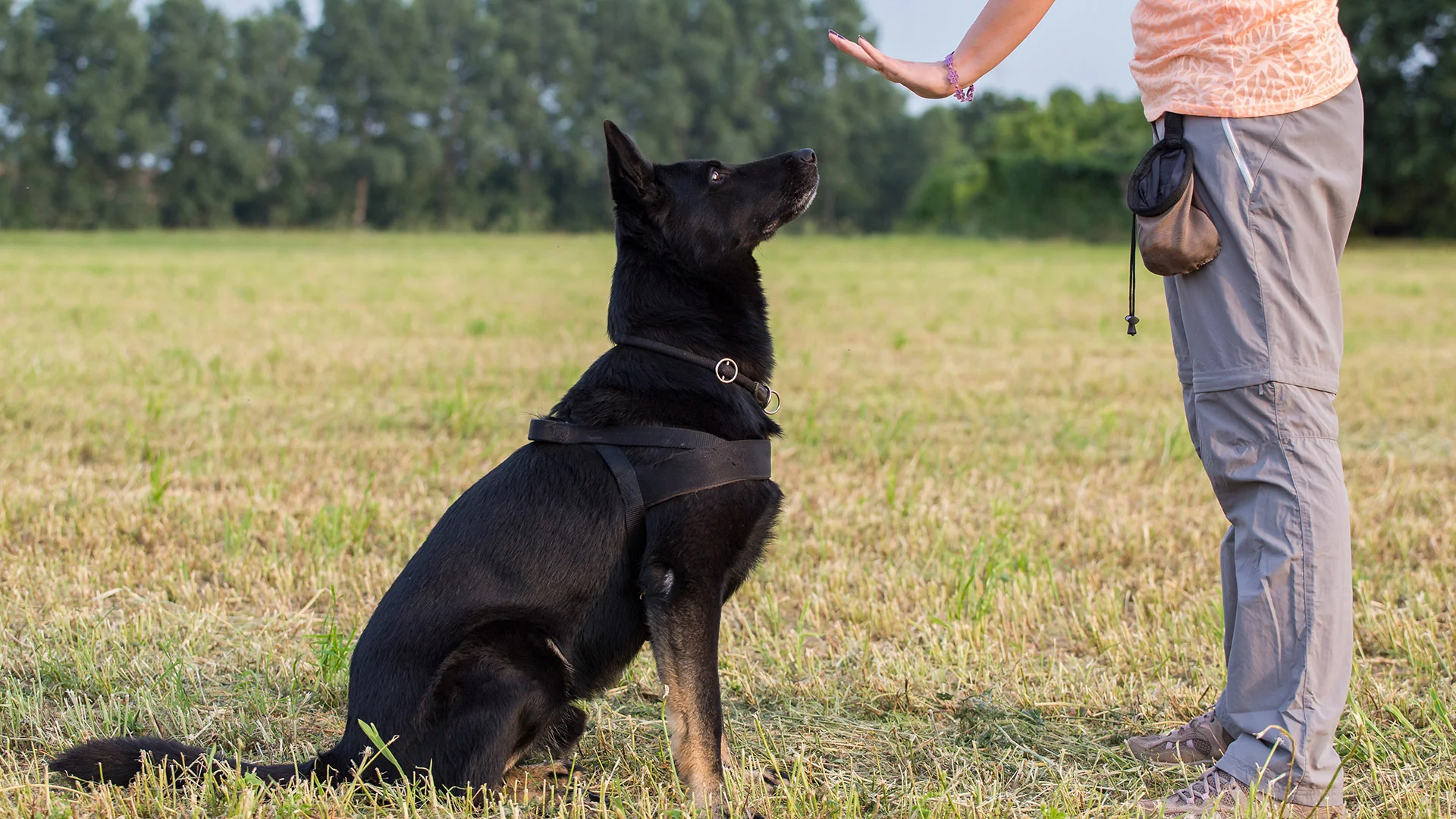
Preparing a service-dog team means preparing the human handler as well as the dog. Service Dog Standards (SDS) works alongside the Americans with Disabilities Act (ADA): the ADA protects access rights and sets legal requirements, while SDS provides detailed training and behavior standards and foundational handler education. The United States Service Dog Registry (USSDR) is powered by SDS, connecting voluntary registration with this educational framework. Trainers use that foundation to explain what training involves and what both partners are responsible for, giving clients shared expectations before individual instruction. Those expectations matter for program-trained, privately trained and owner-trained teams.
Service dog access is a disability accommodation protected by law. A service dog must be individually trained for disability-related work or tasks and must meet the applicable behavior requirements. Tasks may assist with physical, sensory, psychiatric, intellectual, or other mental disabilities.
Psychiatric service dogs follow the same federal access rules as other trained service dogs. ADA public access does not require a doctor’s letter. For covered airline travel, airlines may require the DOT service-animal form and, for flight segments of eight hours or more, the DOT relief-attestation form. A psychiatric-service-dog prescription is not an additional airline requirement. Housing and employment use separate accommodation processes. Voluntary registration does not create access rights.
Do not misrepresent a pet or an emotional support animal as a trained service dog. State laws and penalties differ. Voluntary registry membership does not establish that a dog meets the legal definition.
Plan for a minimum of 120 hours of service-dog training, including at least 30 hours preparing for public work. These minimum training benchmarks give the team a foundation to build on. Continue until the dog’s disability-related tasks, public behavior and the human handler’s skills are reliable; reaching an hour total is not the end of training. Maintain those skills throughout the partnership.
Our mantra is document, document, document. We highly suggest keeping a notebook or a blog as a log or record of your training dates and accomplishments. It will not only serve to help you during the training process but will also serve as a useful paper trail for your Service or Assistance Dog.
The ADA’s service-animal access provisions apply to dogs already trained for disability-related work or tasks. Some state or local laws extend access to dogs in training. Follow the rules that apply where you are training.
Basic Obedience
Your dog must obey basic verbal and/or hand signal obedience commands such as Sit, Stay, Come, Down and Heel. When off leash, your dog must come when called.
Your Dog’s Behavior Your dog must also display good behavior and social skills including:
- No aggressive behavior toward people or other animals; no biting, no snapping, no growling, no mounting, no lunging and/or barking;
- No begging for food or petting from other people;
- No sniffing merchandise or people who pass by;
- No urinating or defecating in public unless given a command/signal to eliminate in an appropriate place.
A service dog performs individually trained work or tasks directly related to a disability. A trained response that interrupts a psychiatric episode can qualify. Comfort from a dog’s presence alone does not. When the role is not obvious, staff at ADA-covered public places may ask whether the dog is required because of a disability and what work or task it has been trained to perform. They cannot request a diagnosis or a task demonstration.
What does individually trained mean?
A dog is taught to perform specific disability-related work or tasks. A naturally offered behavior can become a task when it is deliberately trained and reliably performs that function. Mere companionship, emotional support, or a protective temperament does not qualify.What is a trained task?
A physical task is a chore or behavior that a Service or Assistance Animal performs, on command or cue, to help a disabled person with something that they can not easily do for themselves.A physical task must also be quantifiable in some way, such as fetching a medicine bottle for someone who is having a seizure, opening doors or drawers for someone who has physical mobility issues or alerting on glucose levels for a diabetic.
Examples of some things that would not be an appropriate physical task would be simply providing companionship, emotional support, guarding, protecting or even tasks performed merely for convenience such as fetching the morning paper.
If you need more clarification, please seek a local Service Dog trainer for help.
Appearance
Your dog should appear clean and well groomed at all times. Some Service and Assistance Dog handlers feel that a vest or I.D. is very helpful, even though it is not required by law. A handler’s clothing or appearance does not determine whether the dog is a service animal.
Your Behavior
Please remember to be confident, polite, courteous and respectful at all times, even if you encounter someone who is unfamiliar with the ADA. Be prepared to explain what tasks your dog is trained to complete to help manage your disability. You do not need to explain your disability. Keep in mind that the impression you leave with someone may be their only experience with a Service or Assistance Dog team.
Passing a Public Access Test
The best tool for evaluating a team’s readiness to graduate or finish formal training is a Public Access Test like the one available at ADI. It may be administered by a friend or family member, but again, keeping a video recording of your animal passing the test may prove valuable in the future.
Sources
- Department of Justice: Service Animal FAQs
- DOT documentation rule, 14 CFR 382.75