

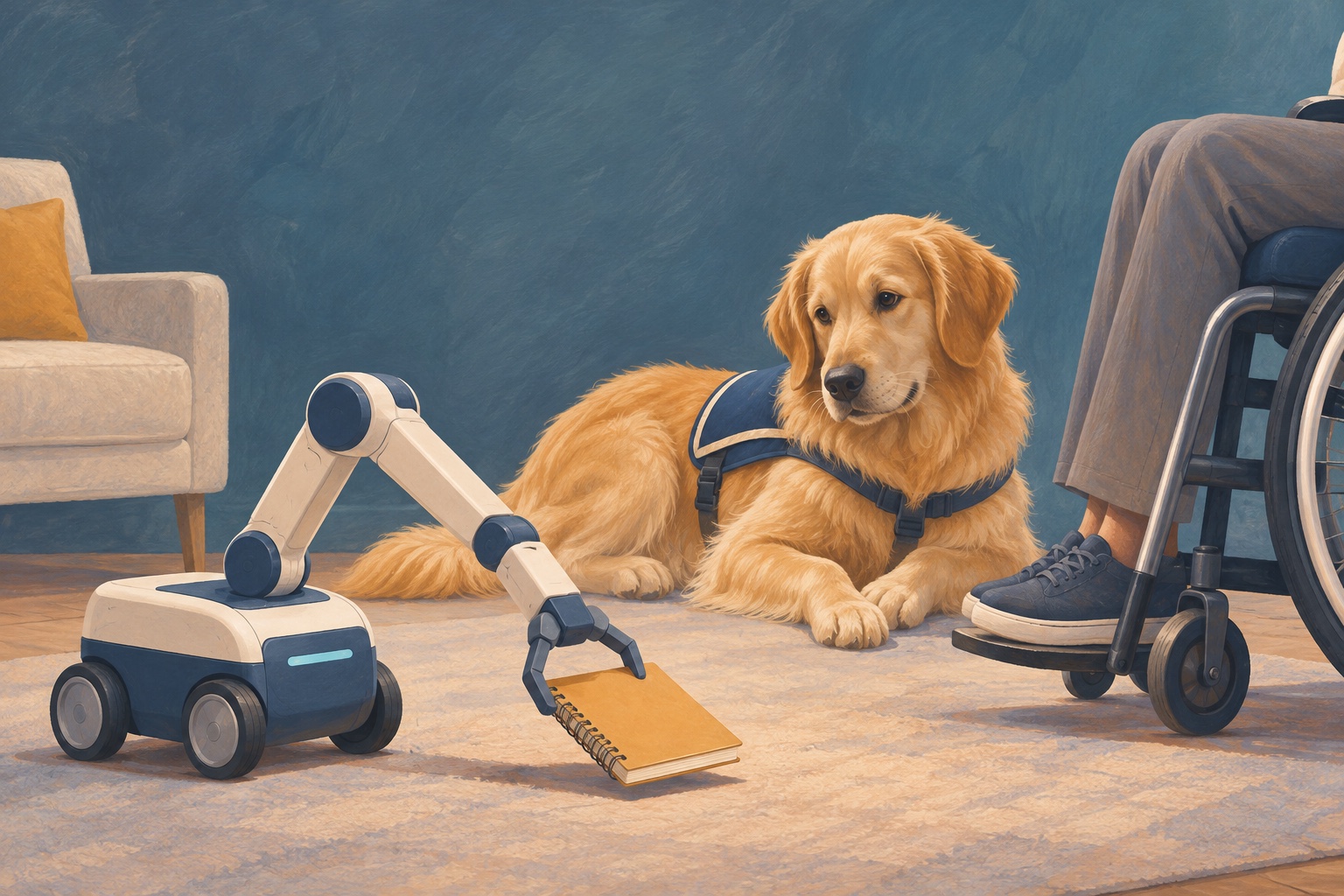
A dropped phone can turn a small interruption into a request for help. Georgia Tech’s EL-E project explored whether a person could point to an everyday object and have a robot bring it within reach. The research gave AP’s 2008 question about robots and assistance dogs a concrete starting point: object retrieval.
What EL-E could do
In its original project description, dated March 7, 2008, Georgia Tech’s Healthcare Robotics Lab explains how a green laser pointer let the user indicate an object or destination. The robot estimated that location in three dimensions, approached it and adjusted the height of its arm and sensors to work at a floor or tabletop.
After grasping an object, EL-E could put it on a selected raised surface or deliver it to a seated person indicated with the pointer. The design took advantage of a familiar feature of homes: many things we need are resting on relatively flat surfaces.
The project was directed by Charlie Kemp in collaboration with Jonathan Glass of Emory’s ALS Center. Its stated purpose was to fetch everyday objects for people with severe motor impairments. That is a specific research aim; the project page does not establish that EL-E was a generally available household product or a substitute for every task a service dog might perform.
Start with the task you need help with
For someone comparing assistive options, “Can it fetch?” is only the beginning. Consider the objects you actually drop, the surfaces they land on and the place where you need them delivered. A remote control on an open floor presents a different practical problem from a key under furniture.
Then consider how you would give the instruction. EL-E’s pointer was part of the task, so the user’s ability to aim it mattered. For any device you are considering today, ask to try its controls yourself rather than relying on a demonstration operated by someone else.
- Can you use the controls comfortably, including on a difficult day?
- Does the system work with your actual objects, floor surfaces and available space?
- What happens when it cannot reach or grip something, loses power or needs maintenance?
- What other tasks would still require a person, a trained dog or a different tool?
What the research answers—and what it leaves open
EL-E demonstrated an approach to retrieving objects. Deciding whether technology could replace a particular service-dog task requires evidence about that task and the person’s circumstances. It also requires a workable backup when the chosen support is unavailable.
This article preserves the original 2008 reporting context and adds an explanation of the research. Use the lab’s description to understand EL-E; seek a current demonstration, specifications and support information before making a decision about any assistive product.