
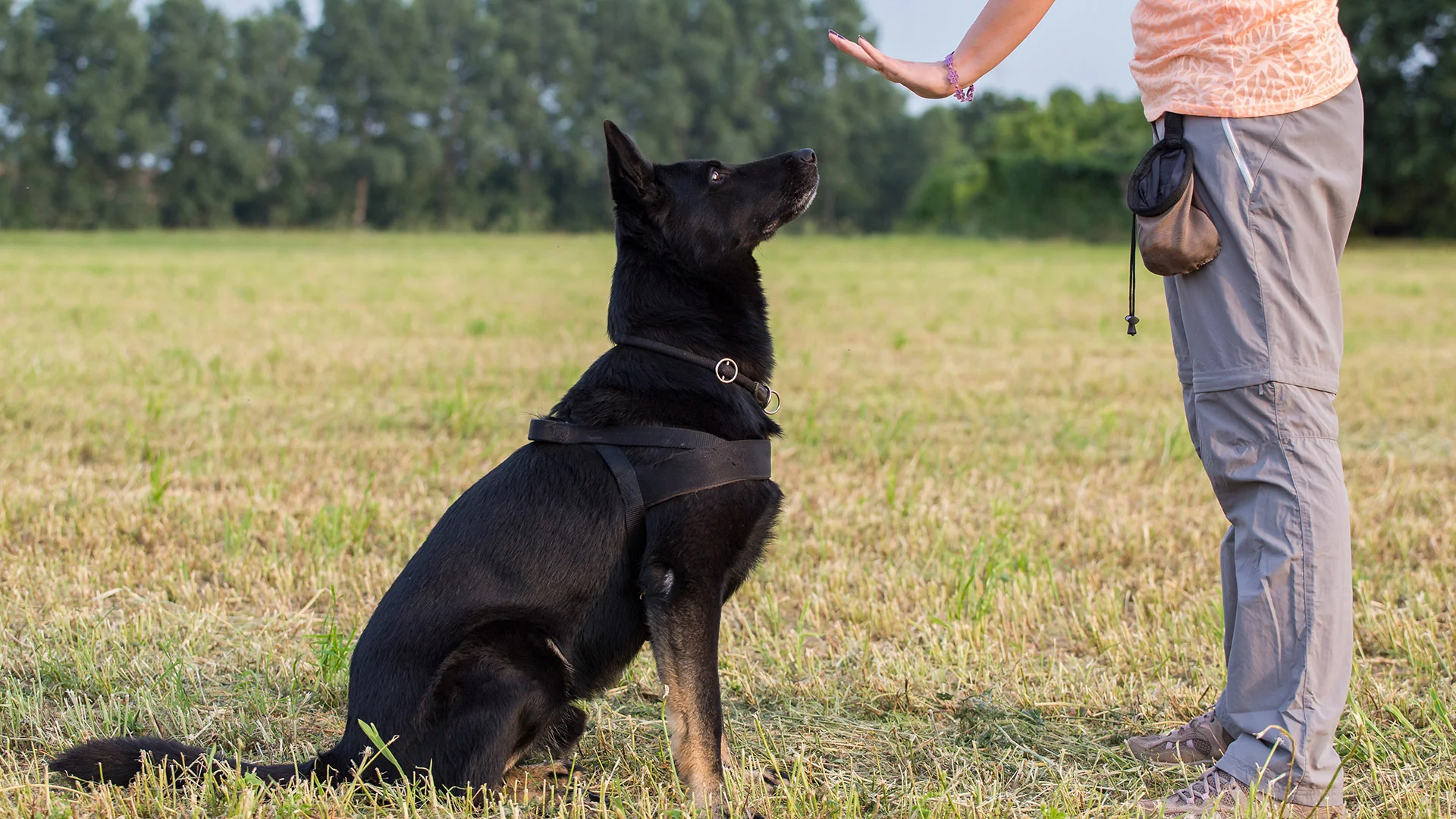
Under ADA public-access rules, a service dog is individually trained in disability-related work or tasks. Readiness involves the actual dog, person and setting; no federal ADA rule prescribes a universal training-hour total or minimum of two tasks.
Choose a humane plan
Owner-training is permitted under the ADA. A suitable trainer or program can provide support, but a certificate or registration does not itself qualify the dog. Training time varies and success is not guaranteed.
Use reward-based methods, teach useful tasks in manageable steps and maintain the dog’s care, rest and welfare. Ordinary natural comfort is not a trained task, but a naturally offered behavior can form part of a deliberate training process.
Public access
A dog must be housebroken and under control. Where its role is not obvious, staff may ask about disability-related need and trained work, not demand a diagnosis, certification or demonstration.
A dog out of control without effective corrective action, or not housebroken, may be excluded while the person is still offered the service without it. Identifying gear is optional under the ADA; effective control remains required.
Voluntary standards
Preparing a service-dog team means preparing the human handler as well as the dog. Service Dog Standards (SDS) works alongside the Americans with Disabilities Act (ADA): the ADA protects access rights and sets legal requirements, while SDS provides detailed training and behavior standards and foundational handler education. The United States Service Dog Registry (USSDR) is powered by SDS, connecting voluntary registration with this educational framework. Trainers use that foundation to explain what training involves and what both partners are responsible for, giving clients shared expectations before individual instruction. Those expectations matter for program-trained, privately trained and owner-trained teams.
Plan for a minimum of 120 hours of service-dog training, including at least 30 hours preparing for public work. These minimum training benchmarks give the team a foundation to build on. Continue until the dog’s disability-related tasks, public behavior and the human handler’s skills are reliable; reaching an hour total is not the end of training. Maintain those skills throughout the partnership.
Logs and public-access assessments may be useful feedback. They are not federal ADA requirements. Housing, employment, airline travel and dogs in training have different rules; psychiatric service dogs do not need a special physician letter for ordinary ADA public access.
Represent status honestly and check the actual applicable law rather than assuming every misrepresentation is covered by a single federal fraud rule.