

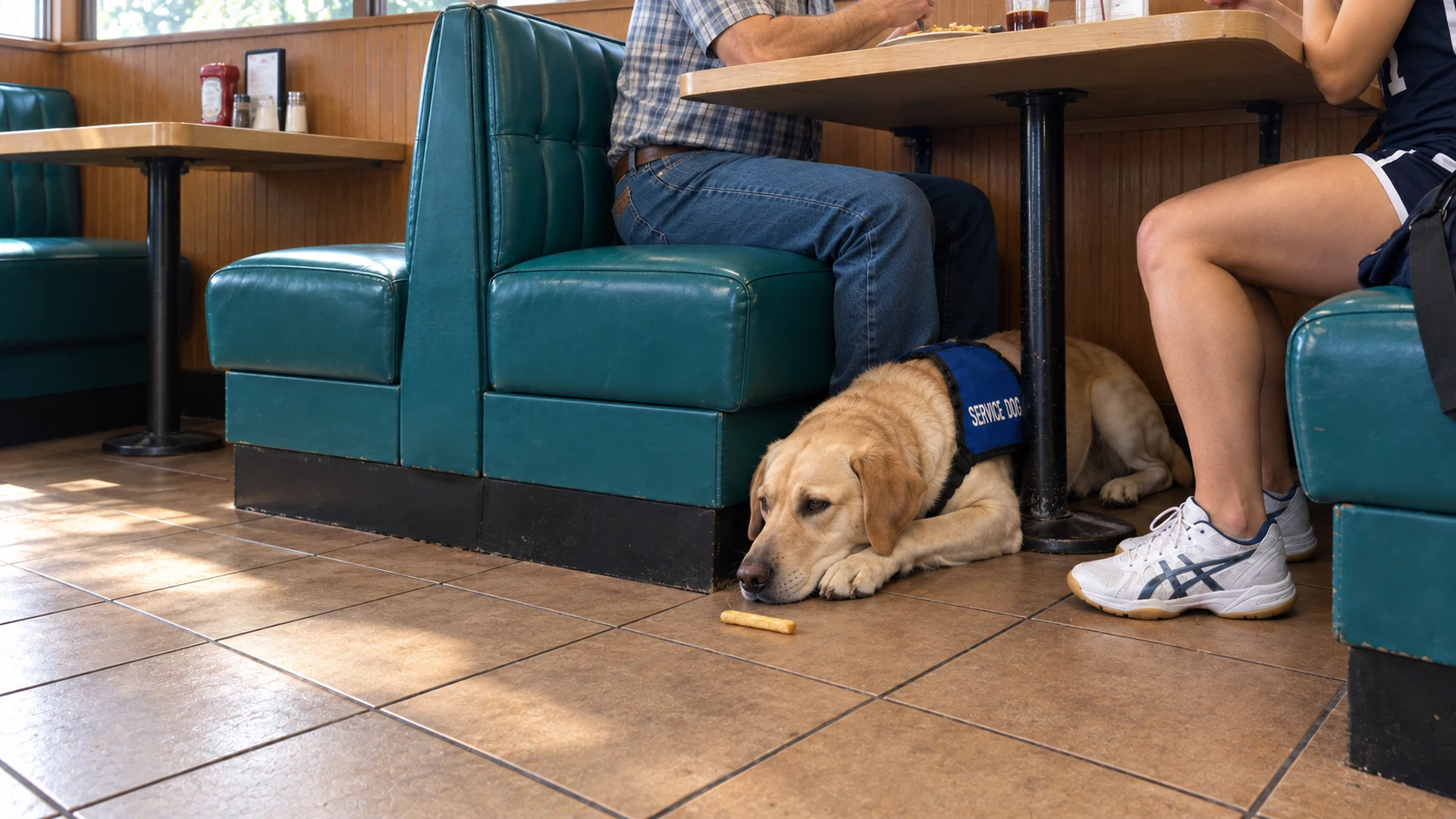
I let my first service dog eat dropped food at home, then wondered why he wouldn’t leave it alone in restaurants. With my second dog, I changed that routine. I wanted to hear how other handlers prepared to go out to eat, too, so I interviewed Star and Kevin, two other handlers with different disabilities and levels of experience, about the practice that helped them and what they would recommend.
Star and Kevin looked back on training their first service dogs. I was training my second dog myself, with a few things I wished I’d understood the first time.
Star and Milo: Practicing with a trainer
Star and Milo had been partnered for a while when we spoke, and they’d finished their sessions with the trainer in 2025. Milo was her first service dog. She looked back on preparing for restaurant visits, when she wanted to enjoy lunch out with friends without worrying about how to get him settled.
The trainer guided Star and Milo through their service-dog training. For restaurant visits, they focused on “leave it” and “tuck.” “Leave it” asked Milo to leave something alone, such as food on the floor. “Tuck” asked him to move into the space beneath a table and settle comfortably out of the way. Star practiced both at home between training sessions.
After practicing at home, Star met the trainer for a snack in the little kitchen at the training facility. It gave him a chance to watch her use both cues while she ate and talked. Any table and chairs would do for this kind of practice.
Star used “tuck” to get Milo settled beneath the table. While they ate, they dropped pieces of food on the floor so she could practice “leave it” with him.
Afterward, they took Milo outside for a “treat party.” Star made a big, theatrical fuss over him, praising him enthusiastically and giving him treats.
Then came lunch with friends
Star went to the restaurant with her friends, without the trainer. They already knew Milo well and understood that when he was wearing his vest, he was working. They knew to leave him alone rather than pet him or try to get his attention.
Star was pleasantly surprised that all the practice at home and with the trainer paid off. Milo stayed tucked beneath the table throughout lunch, resting quietly out of the way while she ate and talked with her friends.
Kevin: Tucks and tether training at home
Kevin had lived with a disability all his life. It became more limiting over time, but its effects weren’t always visible. When he first started taking his dog to restaurants, he dreaded the outings. On days when people couldn’t see his disability, he felt especially self-conscious about being there with a service dog.
Kevin worked with several service dogs over the years. He recalled training his first dog, who found food especially tempting. Leaving it alone took plenty of practice, but the dog learned to do it. Kevin started with short waits and gradually made them longer, rewarding the dog for leaving the food alone.
He also recommended practicing tucks regularly at home. Getting into position beneath a table and staying there needed to be familiar before a restaurant visit. Because Kevin’s mobility varied, he practiced giving cues while seated, too.
Tether training was especially useful for Kevin. A supervised leash connection let him practice having his dog settle calmly beside him while he sat, gradually building the time the dog could remain relaxed there. AP’s guide explains the equipment and supervision involved.
Kevin’s advice was to choose a restaurant with booths and ask to sit in one. A booth could give his dog a sheltered place to tuck beneath the table, clear of the aisle and passing feet. He also needed a booth he could get in and out of comfortably, with enough space underneath for the dog to rest.
Meredith: What I changed with my second dog
My parents used to joke that they wished they could have started with their second child, after making their mistakes with the first. I remembered that joke while training my second service dog.
Letting my first dog eat off the kitchen floor made “leave it” harder
I worked with a trainer on my first dog. He settled well through meals and coped with what happened around us. But if food stayed on the floor long enough, he eventually ate it. I couldn’t seem to make “leave it” last.
At home, I let him clean up dropped food in the kitchen. It was helpful, and I didn’t think much about it. Then I expected him to leave food alone in restaurants, without teaching him when he could eat from the floor and when he couldn’t. Allowing it at home made “leave it” harder when we were out in public, and I regretted it.
With my second dog, I kept dropped food off-limits at home. I did more sweeping and gave him his rewards directly. We practiced settling while I ate, leaving food alone and staying in place while I picked something up.
I stopped treating a dropped scrap as a harmless “special treat.” Letting him have it would teach him something, too. I needed to pay attention to what I was rewarding during an ordinary day, not just when I’d set aside time to train.
For our first restaurant visit, I chose a quiet time and a table with enough room for him to lie comfortably. He settled well, although I was watching the floor almost as much as I watched him. He noticed some nearby crumbs. I gave a quiet “leave it” and rewarded him when he turned back to me.
When we returned with friends, I asked everyone to avoid offering him food beneath the table and to leave anything they dropped for us to pick up.
A piece of bread fell during lunch. With my first dog, I would have been waiting for him to make his move. My second dog looked toward it but stayed where he was. My friend picked up the bread, I rewarded him, and we carried on talking.